Nifty 50 vs Nifty Next 50: Which Index Should You Pick?
Nifty 50 vs Nifty Next 50 compared: weightage, P/E and P/B, 5-year returns on Rs. 1 lakh, and how to invest through index funds or ETFs.
An index is simply a basket of stocks combined in fixed proportions, known as its weightage. Not every stock is part of every index. India has two exchanges — the Bombay Stock Exchange (BSE) and the National Stock Exchange (NSE) — and each maintains its own set of indices. Some indices are based on market capitalization, while others follow specific themes. The weightage of each stock in an index is decided by its free-float market capitalization.
Nifty 50 and Nifty Next 50
Both indices belong to the NSE and are built on free-float market capitalization. Here is what each one represents.
Nifty 50
Nifty 50 is the most popular index on the NSE, made up of the top 50 stocks by market capitalization. It sets the tone for the broader Indian market. However, the index is heavily concentrated — Reliance and HDFC Bank together carry a weightage of around 18%.
Nifty Next 50
Nifty Next 50 covers the stocks ranked 51 to 100 by market capitalization, weighted the same way. Because these are not the first 50 companies of the Nifty, the index mixes large-cap and mid-to-large-cap companies, which makes it more volatile than Nifty 50. This index is not traded in derivatives.
How Rebalancing Works
Both indices are rebalanced twice a year, with cut-off dates of 31 January and 31 July. At each rebalancing, any Nifty 50 company that has slipped in market capitalization is replaced by the highest-valued company from Nifty Next 50. In this way, Nifty 50 always holds high-value, premium companies, while Nifty Next 50 keeps giving up its best performer every year. This rotation can move stock prices: many mutual funds run Nifty 50 index funds, so when a stock enters or leaves the index, these funds must buy or sell it — which can create price swings for those companies.
Current Top 10 Companies in Nifty 50 and Nifty Next 50
Here are the top 10 stocks in each index by weightage, based on free-float market capitalization.
Nifty 50 is highly concentrated in just three stocks — HDFC Bank, ICICI Bank, and Reliance — which together account for about 28% of the index, leaving the remaining 47 stocks to share roughly 72%. In Nifty Next 50, the single largest holding is only 4.04%, which means your money is spread almost evenly across the index rather than concentrated in a few names.
Top 10 Nifty 50 Stocks by Weightage
| Rank | Stock | Weightage (%) |
|---|---|---|
| 1 | HDFC Bank | 10.27 |
| 2 | ICICI Bank | 9.22 |
| 3 | Reliance Industries | 7.92 |
| 4 | Bharti Airtel | 5.37 |
| 5 | Larsen & Toubro | 4.13 |
| 6 | State Bank of India | 3.81 |
| 7 | Infosys | 3.55 |
| 8 | Axis Bank | 3.16 |
| 9 | Bajaj Finance | 2.74 |
| 10 | Mahindra & Mahindra | 2.72 |
Top 10 Nifty Next 50 Stocks by Weightage
| Rank | Stock | Weightage (%) |
|---|---|---|
| 1 | Divi's Laboratories | 4.04 |
| 2 | TVS Motor Company | 4.00 |
| 3 | Tata Motors | 3.60 |
| 4 | Hindustan Aeronautics | 3.48 |
| 5 | Adani Power | 3.46 |
| 6 | Cholamandalam Investment | 3.16 |
| 7 | Torrent Pharmaceuticals | 2.97 |
| 8 | Cummins India | 2.94 |
| 9 | Samvardhana Motherson | 2.63 |
| 10 | Indian Hotels | 2.56 |
Weightages are from the official NSE Indices factsheets dated 31 July 2026.
Index Fundamentals
Nifty 50 currently trades at a P/E of 20.78, a P/B of 2.99, and a dividend yield of about 1.22%. It has moved sideways for the last two years and sits roughly 10% below its all-time high. Nifty Next 50 trades at a P/E of 19.49, a P/B of 3.47, and a dividend yield of about 1.21%, leaving it only 3–4% below its all-time high. Nifty Next 50 also carries a higher beta, which means it gains more momentum in both directions depending on market conditions. On the other hand, stock options on Nifty 50 are far more liquid than those on Nifty Next 50.
Chart Comparison: Nifty 50 vs Nifty Next 50
Here is the weekly chart of Nifty 50 over the last 5 and 10 years:
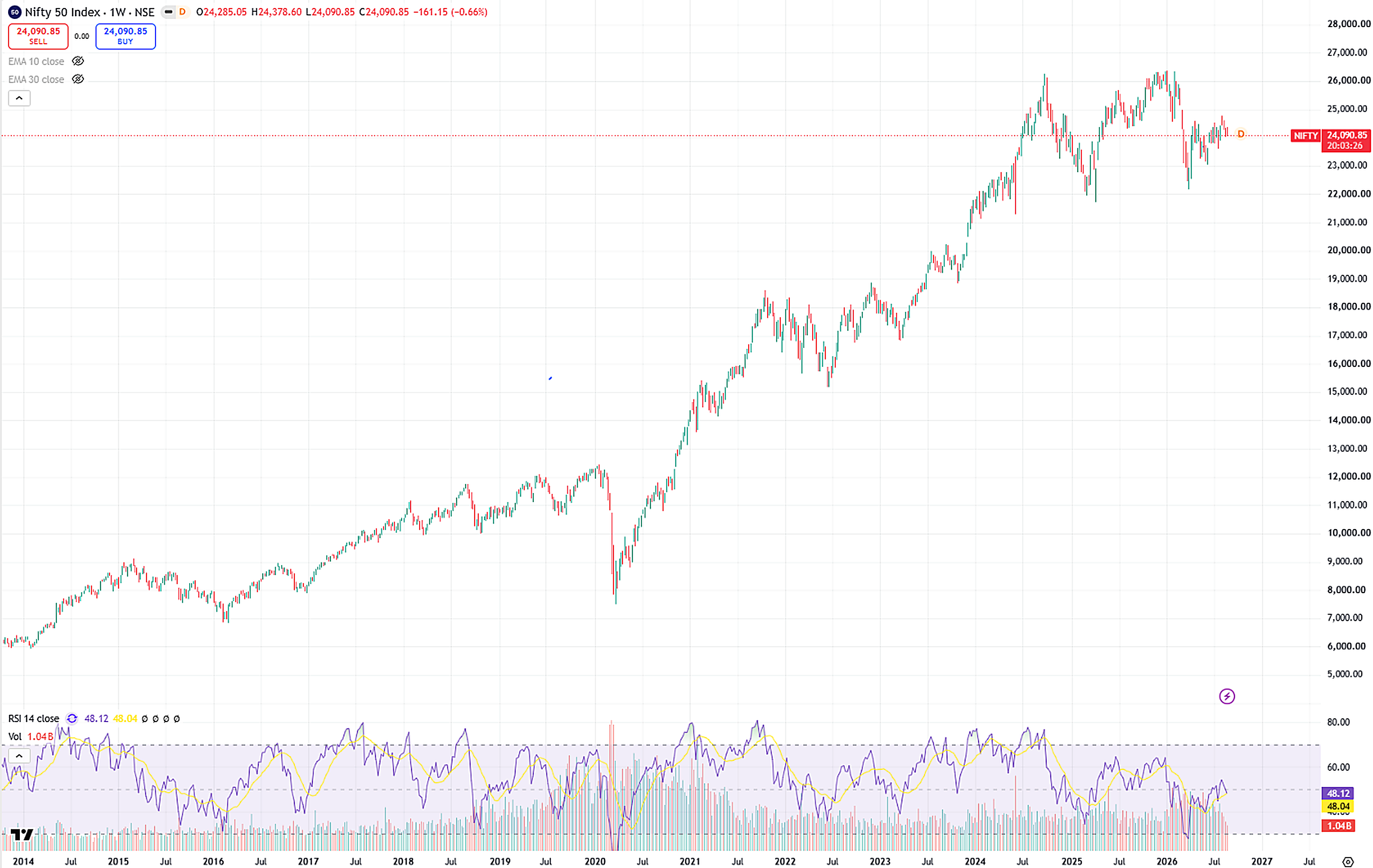
And here is the weekly chart of Nifty Next 50 over the same period:
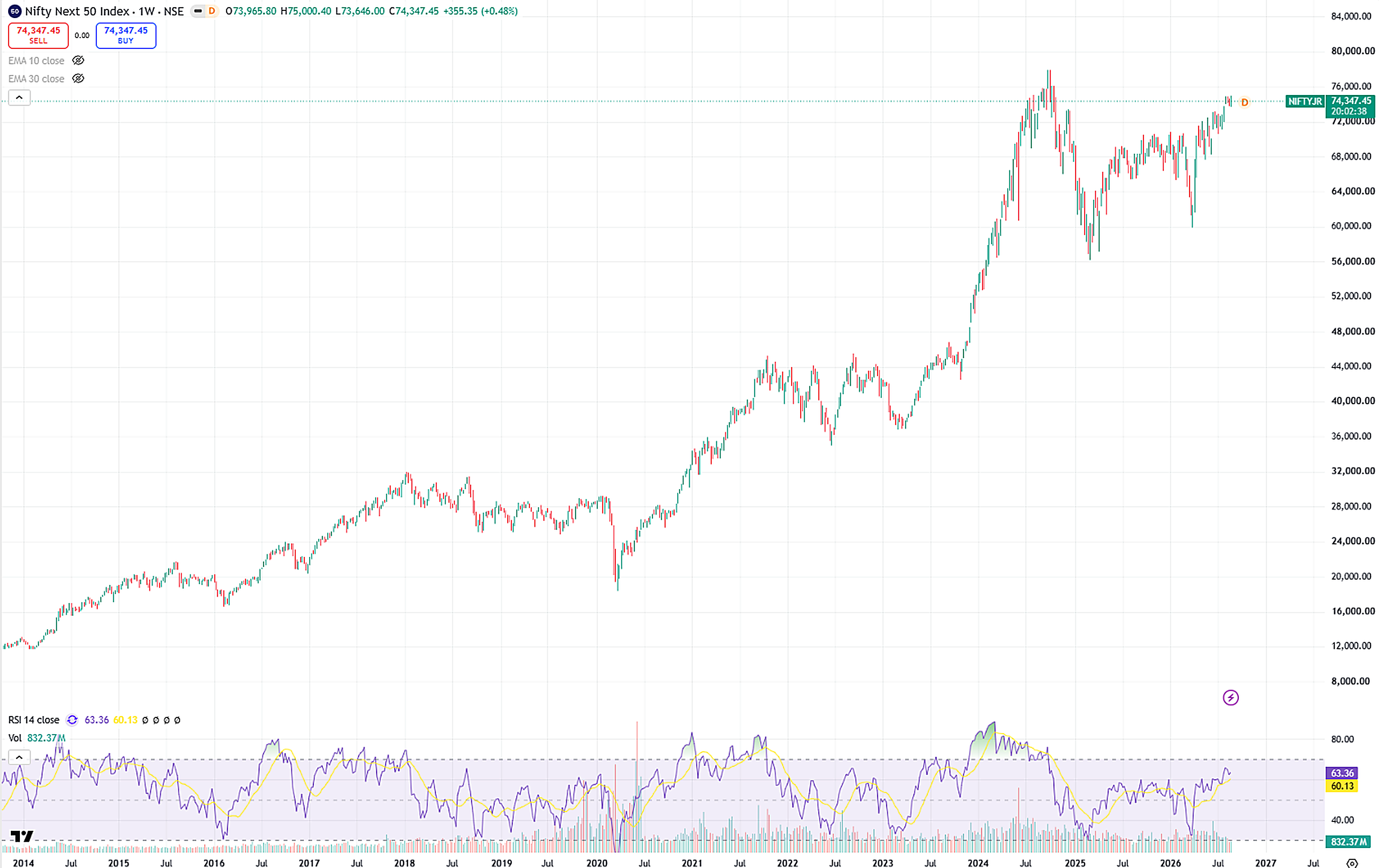
Looking at the charts, Nifty 50 has climbed from about 8,500 ten years ago to an all-time high of roughly 26,300 — a gain of around 200%, or about 3x. Over the same period, Nifty Next 50 rose from about 20,000 to an all-time high near 78,000 and now trades around 76,000 — a gain of roughly 280%, or about 3.8x. So whether you look at five years or ten, Nifty Next 50 has delivered clearly stronger performance than Nifty 50.
Here is how ₹1,00,000 invested five years ago would have grown in each index, based on the official 5-year CAGR:
| Index | 5-Year CAGR | Value of ₹1,00,000 |
|---|---|---|
| Nifty 50 | ~10.9% | ~₹1.68 lakh |
| Nifty Next 50 | ~15.5% | ~₹2.06 lakh |
How to Invest in These Indices
There are two ways to invest in Nifty 50 or Nifty Next 50: index funds and ETFs. Here are the top 5 index funds and top 5 ETFs for each index.
Nifty 50: Top Index Funds vs ETFs
| Index Funds | ETFs |
|---|---|
| UTI Nifty 50 Index Fund | Nippon India ETF Nifty 50 BeES (NIFTYBEES) |
| HDFC Index Fund – Nifty 50 Plan | SBI Nifty 50 ETF (SETFNIF50) |
| ICICI Prudential Nifty 50 Index Fund | HDFC Nifty 50 ETF (HDFCNIFETF) |
| SBI Nifty Index Fund | ICICI Prudential Nifty 50 ETF (NIFTYIETF) |
| Nippon India Index Fund – Nifty 50 Plan | UTI Nifty 50 ETF (UTINIFTETF) |
Nifty Next 50: Top Index Funds vs ETFs
| Index Funds | ETFs |
|---|---|
| UTI Nifty Next 50 Index Fund | Nippon India ETF Nifty Next 50 Junior BeES (JUNIORBEES) |
| ICICI Prudential Nifty Next 50 Index Fund | SBI Nifty Next 50 ETF (SETFNN50) |
| HDFC Nifty Next 50 Index Fund | HDFC Nifty Next 50 ETF |
| SBI Nifty Next 50 Index Fund | ICICI Prudential Nifty Next 50 ETF |
| Nippon India Index Fund – Nifty Next 50 Plan | UTI Nifty Next 50 ETF |
Funds and ETFs are listed by popularity and size; expense ratios and AUM change over time, so verify the current figures before investing.
Manual investing is also possible by buying all 50 companies in proportion, but that requires 50 buy orders and 50 sell orders when you exit, which drives up your costs. The holdings would also need to be adjusted manually whenever a new company enters the index, which demands constant tracking. The upside is that dividends are received directly and can be kept, which is not possible with index funds or ETFs — so an average difference of 1–2% can be expected here.
Why Index Funds and ETFs Don't Match the Index
Index funds and ETFs cannot move at exactly the same daily rate as the index. The index is only a weighted representation. Real investing requires buying and rebalancing shares, which involves charges such as STT. Dividends are additional cash received by ETFs and index funds, and they never reinvest that cash. Because of these factors, a small slippage develops between the actual index and the ETF or index fund. The more liquid the fund, the smaller the slippage.
Conclusion
Nifty 50 is less volatile than Nifty Next 50. If you want more growth with momentum, Nifty Next 50 is the better investment, while Nifty 50 suits investors who prefer stability and moderate returns. Over both five and ten years, Nifty Next 50 has outperformed Nifty 50, largely because it starts from a more evenly distributed, mid-cap-heavy base. At the same time, Nifty 50's concentration in a few large names makes it steadier, with deeper and more liquid options markets. Your choice ultimately depends on your risk appetite and time horizon — those who can tolerate higher swings may favor Nifty Next 50, while conservative investors may find Nifty 50 more comfortable.
References
- NSE Indices — Nifty 50
- NSE Indices — Nifty Next 50
- NSE Indices — Nifty 50 Factsheet (PDF)
- NSE Indices — Nifty Next 50 Factsheet (PDF)
- NSE Indices — Nifty 50 Constituents
- NSE Indices — Nifty Next 50 Constituents
Top-10 weightages, P/E, and P/B are from the official NSE Indices factsheets dated 31 July 2026.
This article is for educational purposes only and does not constitute investment advice. Please consult a SEBI-registered investment adviser before making any investment decision.
Related Articles


Stay ahead on finance & AI
Weekly articles on personal finance, investing strategies, and how AI is changing the way we manage money. Free. No spam.
Join free · Unsubscribe anytime · We never share your email.