Best Way to Buy Gold in India: 4 Options Compared
Physical gold, digital gold, gold ETFs, and gold mutual funds compared — costs, taxation, and the best way to buy gold this Diwali in India.
Festival season is here, and people across India traditionally buy gold during this time. There are several ways to buy gold in India: physical gold, digital gold, gold ETFs, and gold mutual funds. Another good option used to be Sovereign Gold Bonds, but that scheme is no longer available. Let's go through each option and weigh its pros and cons.
Physical Gold
With physical gold, you go to a jewellery shop or use an online app and buy 24-karat gold bars or coins for a set amount. We are not talking about gold jewellery, which carries making charges of 30% to 40% and is not 100% pure — with physical gold, you should buy only coins or bars. One issue is that you have to store it safely, either at home or in a bank locker, and a bank locker carries its own annual fee. You also pay GST when you buy and tax on any profit when you sell, and you have to visit a jewellery shop in person to sell it.
Let's look at an example.
Say you decide to buy a 10-gram, 24-karat gold coin from MMTC-PAMP. If the spot price is ₹16,000 per gram, then 10 grams cost ₹1,60,000. On top of that, you pay a brand premium — say 3% with a seller like Tanishq or MMTC-PAMP, which comes to ₹4,800. Then you pay 3% GST on that subtotal, which is ₹4,944, bringing the total to ₹1,69,744. When you sell gold you already own, the government does not charge GST on the sale — GST only applies when you buy.
Now, if you sell it the next day and the gold price stays the same, the 10 grams are still worth ₹1,60,000, but the buyer deducts a 3% to 4% buyback charge — at 3%, that's ₹4,800 — leaving you with about ₹1,55,200. The difference is a loss of ₹14,544, or roughly 8.5% of what you paid. In short, the price needs to rise by about 8.5% just for you to break even.
If you hold the gold for more than 2 years and then sell it at a profit, you pay long-term capital gains tax, which is 12.5%. If you sell within 2 years, the profit is taxed at your personal income tax slab rate — so if you fall in the highest slab of 30%, you would pay 30% tax on your gold profit.
Here is how the top brands in India compare on gold coin premiums:
| Brand | Purity | Making Charge (Coins) | Buyback Rate |
|---|---|---|---|
| MMTC-PAMP | 24K, 99.99% (LBMA-certified) | About ₹100/gram (~0.6%) | 99%–100% |
| Tanishq | 24K, 99.9% | 5% on smaller coins, 9% on 10g coins; often ₹0 during festive offers | 98%–100% |
| Malabar Gold & Diamonds | 24K, 99.9% | About ₹150/gram (~0.9%) | 97%–99% |
| Kalyan Jewellers | 24K | Not separately published for coins | Not published |
Gold spot price was about ₹16,300–16,400 per gram (24K) as of August 2026 and changes daily. Making charges and buyback rates vary by city and change frequently — confirm the current rate with the brand before buying.
What Is MMTC-PAMP?
MMTC-PAMP is a joint venture between MMTC Ltd, a Government of India undertaking, and the Swiss refiner MKS PAMP SA. Set up in 2008, it is the only LBMA-accredited gold and silver refiner in India, which means its bars and coins are accepted on global exchanges and by central banks. It mints 24-karat gold at 999.9 purity — higher than the 995 purity many sellers offer — so its coins enjoy strong resale acceptance. It is also the refiner that backs most digital gold platforms in India.
Digital Gold
Another popular way to invest in gold is digital gold, which many fintech companies in India offer through their apps. Unlike physical gold, there are no minting charges, so you pay only GST, just as you would on physical gold. However, these apps keep a wider gap between their buy and sell prices, even on the same day — this spread is typically 3% to 4% or more. And if you later want to convert your digital gold into physical gold, you have to pay making charges plus home delivery charges.
The tax treatment is the same as for physical gold. The main drawback is this wide spread, since the app usually quotes a lower price when you sell than when you buy. The other concern is safety — if the company shuts down, there is no guarantee you would get your gold or your money back.
So you need to be careful before putting money into digital gold. Here are some of the top digital gold providers in India:
| Platform | Gold Backed By | Buy–Sell Spread | Storage |
|---|---|---|---|
| Paytm Gold | MMTC-PAMP | About 5% | Free for 5 years |
| PhonePe Gold | SafeGold / MMTC-PAMP | About 4%–6% | Free for 7 years |
| Google Pay Gold | MMTC-PAMP | About 5% | Free for 5 years |
| Tanishq Digital Gold | MMTC-PAMP | About 4% | Free for 5 years |
| Jar | SafeGold | About 5%–6% | Free for a lifetime |
Spreads change frequently — always check the live buy and sell quote in the app before transacting.
Gold ETF and Gold Mutual Fund
Another way to invest in gold is through gold ETFs and gold mutual funds. Neither option requires GST, making charges, or delivery charges, and both are safer than digital gold, since ETFs and mutual funds are regulated by SEBI. You do pay a fund management fee for mutual funds, which is usually low, around 0.5% to 1%, and some funds charge an exit load if you redeem within about 20 to 30 days of investing.
Gold ETFs, on the other hand, trade directly on the stock exchange, so you need a demat account to buy them — you can buy and sell gold ETF units just like shares.
The main difference between a gold ETF and a gold mutual fund is the LTCG holding period: for a gold ETF, LTCG applies after holding it for more than a year, while for a gold mutual fund, it is 24 months (2 years). In both cases, the LTCG tax rate is 12.5%, and STCG is taxed as per your income tax slab.
Here are the top gold ETFs in India — these trade on the exchange under their own ticker, so you need a demat account:
| Gold ETF | Ticker | Expense Ratio | AUM |
|---|---|---|---|
| Nippon India ETF Gold BeES | GOLDBEES | ~0.80% | ~₹53,300 Cr |
| ICICI Prudential Gold ETF | ICICIGOLD | ~0.50% | ~₹4,800 Cr |
| HDFC Gold ETF | HDFCGOLD | ~0.59% | ~₹4,100 Cr |
| SBI Gold ETF | SETFGOLD | ~0.65% | ~₹3,400 Cr |
| Kotak Gold ETF | KOTAKGOLD | ~0.55% | ~₹3,200 Cr |
And here are the top gold mutual funds — these are fund-of-funds that invest in the underlying gold ETF, bought like a regular mutual fund with no demat account needed:
| Gold Mutual Fund | Expense Ratio (Direct) | AUM |
|---|---|---|
| SBI Gold Fund | 0.30% | ~₹15,812 Cr |
| HDFC Gold Fund | Not publicly listed | ~₹11,197 Cr |
| Nippon India Gold Savings Fund | 0.35% | ~₹6,959 Cr |
| ICICI Prudential Regular Gold Savings Fund | 0.38% | ~₹6,398 Cr |
| Axis Gold Fund | Not publicly listed | ~₹2,887 Cr |
Expense ratios and AUM as of August 2026; both change over time, so verify the current figures before investing.
Does a Gold ETF or Mutual Fund Actually Track the Gold Spot Price?
Not exactly — the small gap between the two is called tracking error. If gold rallies 20% in a year, a gold ETF or mutual fund will not deliver exactly 20%; it will likely land somewhere between 19.5% and 21.5%.
Gold mutual funds also invest in gold ETFs, so on top of the ETF's own cost, they add their own expense ratio as an additional layer of cost. They also cannot invest 100% of your money in gold — they need to keep some cash on hand so they can pay you directly if you redeem, and that cash sits idle and does not generate any return. On top of that, they also incur vaulting and insurance costs to store their gold holdings securely.
In addition, keep in mind that if a gold ETF is not liquid or large enough, there will be a wider spread between buyers and sellers, making it harder to get the best price when you sell.
What Happened to Sovereign Gold Bonds?
Another way to buy gold used to be Sovereign Gold Bonds (SGBs) issued by the RBI — this was arguably the best method, but the RBI has stopped issuing new bonds, and you can now only buy them from the secondary market. With SGBs, the government also paid a yearly interest of 2.5%, and if you held the bond to maturity after 8 years, the gains were tax-free. However, if you buy SGBs from the secondary market and sell them before maturity, you do need to pay tax on the gains. This scheme is now discontinued.
Conclusion
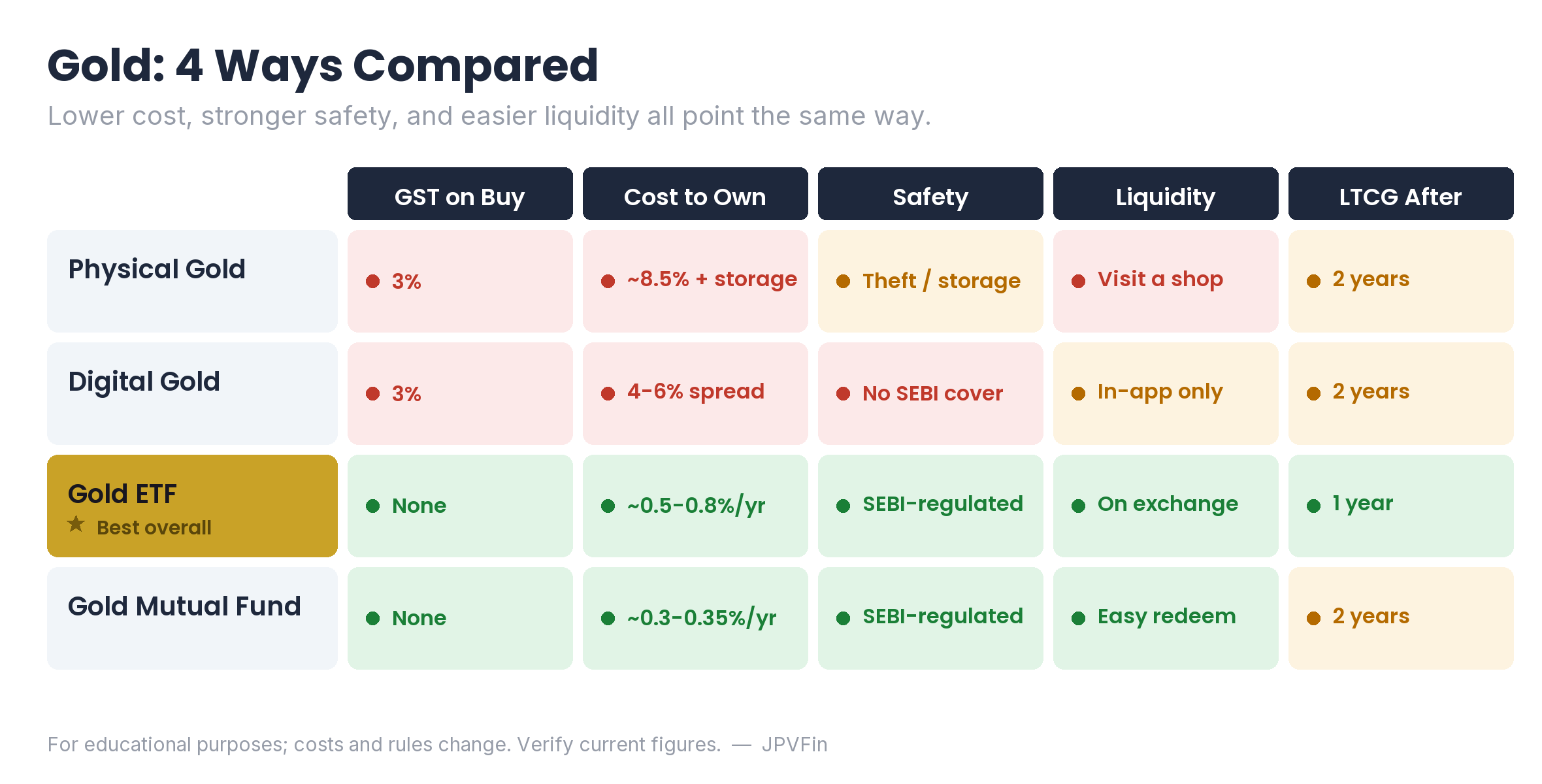
In short, there are four ways to invest in gold: ETFs, mutual funds, digital gold, and physical gold. Each has its own advantages and disadvantages. Based on the data above, here is the pick in each category:
- Physical gold — MMTC-PAMP: the only LBMA-accredited refiner, with the highest purity, the lowest coin premium, and the best buyback rate.
- Digital gold — Tanishq Digital Gold: the tightest buy-sell spread among the major apps, backed by MMTC-PAMP gold.
- Gold ETF — Nippon India Gold BeES (GOLDBEES): the largest and most liquid, so it has the tightest on-exchange spread; ICICI's ETF is the cheapest on expense ratio.
- Gold mutual fund — SBI Gold Fund: the largest by a wide margin and the lowest expense ratio, with no demat account required.
However, if we compare all four options as a whole on safety, security, and low additional cost, gold ETFs clearly come out ahead.
This article is for educational and informational purposes only and does not constitute investment advice. Please consult a registered investment adviser before making any investment decision.
References
Related Articles


Stay ahead on finance & AI
Weekly articles on personal finance, investing strategies, and how AI is changing the way we manage money. Free. No spam.
Join free · Unsubscribe anytime · We never share your email.