MTF Explained: How Margin Trading Facility Works in India
MTF (Margin Trading Facility) lets you buy shares with your broker's money at daily interest. See an example, broker rates, and a calculator.
· 7 min read
MTF, or Margin Trading Facility, is leverage that a stockbroker provides so you can buy a larger quantity of stock than your own funds allow. You pay a portion of the purchase value as margin, and the broker funds the rest at a fixed daily interest rate. It works like a loan, except the funds never reach your bank account and stay within the stock segment. MTF is available only for buying stocks and ETFs — not for futures and options, and not for intraday trading. Both the leverage a broker offers and the interest rate it charges depend on the stock, since large-cap, mid-cap, and small-cap stocks carry different margin requirements. If you trade futures and options separately, the tax treatment is different again — our F&O turnover and tax calculator works out turnover and whether a tax audit applies.
When to Use MTF: Advantages and Risks
Remember, MTF only works for buying — never for short selling with leverage. That means you should use it only when you're highly convinced a stock will rise from its current price. If the stock doesn't rise after you buy it on MTF — if it stays flat or falls — you take a heavier loss than you would with regular delivery, because leverage and daily interest work against you at the same time. MTF interest is calculated daily on the amount the broker has funded for as long as the position stays open.
Let's understand this with an example.
MTF Example: Buying Reliance Shares on Margin
Suppose you want to buy 1,000 Reliance shares. On Zerodha, buying via MTF costs about ₹2,97,416 plus brokerage and taxes, compared with about ₹13,16,000 for the same 1,000 shares bought through regular delivery. That's about 4.4x leverage — you put up ₹2,97,416 of your own money, and Zerodha funds the remaining ₹10,18,584.
Zerodha's MTF interest rate is 0.04% per day, or about 14.6% per year, charged only on the funded amount — not on your own margin, and not on the full position value.
MTF interest = Funded amount × Daily interest rate × Number of days held
You can run these numbers for any trade below — change the price, quantity, margin and holding period to see the leverage, daily interest, breakeven and net return for your own trade.
MTF Calculator
Open full tool →Your MTF trade
The trade, your broker's rate, and the move you expect.
Each broker is set at its standard rate. Compare all 18 brokers' rates by plan →
Over the whole holding period, not per day.
Net return on your margin if the stock rises 15% in 90 days
+49.2%
₹1.6 L profit on your ₹3.25 L margin after ₹35,100 of interest, against 15% for buying the shares outright.
Interest for 90 days
₹35,100
≈ 14.6% a year
Breakeven move
+2.7%
to cover interest
Position P&L
+₹1.95 L
before interest
Beats delivery above
+3.6%
else buy unleveraged
Who funds the position
- Your margin
- ₹3.25 L
- Broker funds
- ₹9.75 L
- Position
- ₹13 L
How this is worked out. You pay 25% of the position and the broker funds the rest at 0.04% a day. The stock must rise 2.7% in 90 days just to cover that interest; the return on your margin is what is left after it.
Return on your margin vs. the stock's move
After 90 days of interest. The dot marks the move you expect.
Your numbers, step by step
Position value
₹1,300 × 1,000 = ₹13,00,000
Your margin (25%)
₹13,00,000 × 25% = ₹3,25,000
Broker funds & leverage
₹13,00,000 − ₹3,25,000 = ₹9,75,000 funded · 4.00×
Interest · 90 days
₹9,75,000 × 0.04% a day × 90 = ₹35,100
P&L if the stock moves +15%
₹13,00,000 × 15% = +₹1,95,000
Net profit or loss
+₹1,95,000 − ₹35,100 interest = +₹1,59,900
Result
Net return: +49.2% on your ₹3,25,000 margin
The stock only needs to rise +2.7% to cover interest — but MTF beats buying the shares outright only above +3.6%. Below that, plain delivery returns more.
Estimates only — brokerage and taxes (STT, GST, stamp duty) are excluded, MTF interest accrues each day the position is open, and margin % and rates vary by broker, plan, and stock. Broker rates are each broker's standard published rate from our MTF rate tracker, reviewed 10 Sep 2026. Confirm live figures with your broker.
If the stock rises 30% over one year: the position gains ₹3,94,800 (30% of ₹13,16,000). A full year of interest on the funded amount is about ₹1,48,713. Net profit is ₹2,46,087 — a return of about 82.7% on your own ₹2,97,416, well above the stock's own 30% move.
If that same 30% rise happens in three months instead of a year: the gain is still ₹3,94,800, but interest for three months is only about ₹36,669. Net profit is ₹3,58,131 — a return of about 120.4% on your own investment in just three months, excluding brokerage and taxes. This is exactly why MTF is so popular when a trade moves quickly in your favor.
If the stock stays flat for a year: you gain nothing on the position, but a full year of interest on the funded amount still costs about ₹1,48,713 — almost exactly 50% of your own ₹2,97,416 investment, lost purely to interest.
If the stock falls 20% over the year: the position loses ₹2,63,200, and you still owe about ₹1,48,713 in interest. Your total loss is about ₹4,11,913 — about 138.5% of your own ₹2,97,416 investment. In other words, a 20% drop in the stock can wipe out your entire margin and leave you owing the broker more money on top of it.
Here's how the four scenarios compare side by side:
| Scenario | Position P&L | MTF Interest | Net P&L | Return % |
|---|---|---|---|---|
| Stock +30% (1 year) | ₹3,94,800 | −₹1,48,713 | ₹2,46,087 | 82.7% |
| Stock +30% (3 months) | ₹3,94,800 | −₹36,669 | ₹3,58,131 | 120.4% |
| Stock flat (1 year) | ₹0 | −₹1,48,713 | −₹1,48,713 | −50.0% |
| Stock −20% (1 year) | −₹2,63,200 | −₹1,48,713 | −₹4,11,913 | −138.5% |
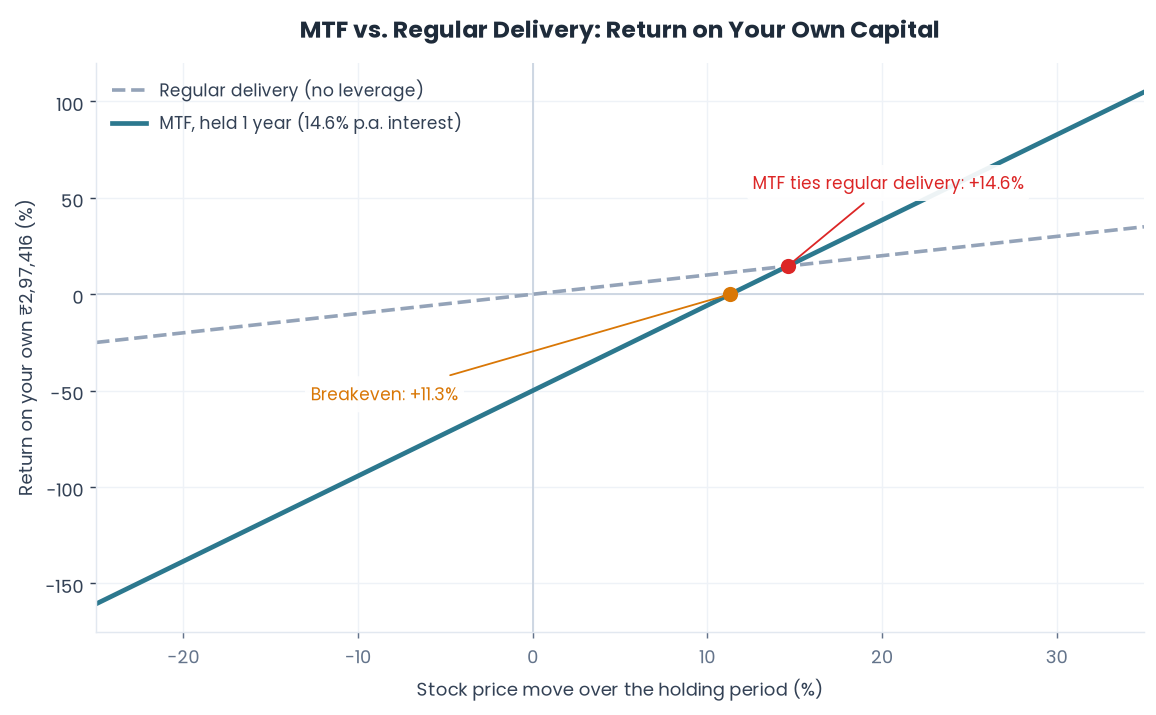
The stock needs to rise just 11.3% to break even on MTF, but MTF only beats plain regular delivery once the move crosses 14.6% — the interest rate itself.
Brokerage on the 1,000-share trade is charged as usual and is the same whether you buy via MTF or regular delivery.
You need to be cautious before taking leverage through MTF. When it moves in your favor, it multiplies your gains; when it moves against you, even a modest loss in the stock can wipe out your capital. Be disciplined and use a proper stop-loss before using MTF.
MTF Interest Rates Across Indian Brokers
MTF interest rates vary widely by broker, and often by your brokerage plan or the stock's margin category. Brokers below are ordered by active client base, most popular first, so you can see at a glance what India's most-used brokers actually charge. Rates in bold are 12% per year or lower.
| Broker | Daily Rate | Annualized Rate |
|---|---|---|
| Groww | 0.041% | 14.95% |
| Zerodha | 0.040% | 14.60% |
| Angel One | 0.041% | 14.99% |
| ICICI Direct | 0.026%–0.049% | 9.65%–17.99% |
| Upstox | ~0.050% | ~18.25% |
| Kotak Securities | 0.027%–0.049% | 9.75%–17.99% |
| HDFC Securities | 0.032% | 12.00% |
| Dhan | 0.034%–0.045% | 12.49%–16.49% |
| Motilal Oswal | 0.053% | 19.50% |
| Paytm Money | 0.026%–0.041% | 9.75%–14.99% |
| Sharekhan | 0.049% | 18.00% |
| Axis Direct | 0.038%–0.049% | 13.99%–18.00% |
| 5paisa | 0.045% | 16.40% |
| Fyers | 0.0493% | 17.99% |
| Pocketful | 0.016%–0.044% | 5.99%–16.00% |
| Rupeezy | 0.030% | 10.99% |
| INDmoney | 0.040% | 14.60% |
| Lemonn | 0.027% | 9.99% |
Broker order reflects active NSE client counts as of mid-2026 (Groww, Zerodha, and Angel One together account for close to six in ten active trading accounts in India); Rupeezy, INDmoney, Lemonn, and Pocketful are smaller and not part of the public top-client rankings. Interest rates are as published by brokers and rate-tracking sites in August 2026, and vary by brokerage plan, the stock's margin category, and your outstanding funded amount. Confirm the current rate on your broker's website before trading.
Some brokers charge MTF interest higher than a typical personal loan rate — if your bank offers a cheaper personal loan, it's worth comparing that against MTF before you decide.
Interest is only part of what a position costs. You can compare brokerage, STT, stamp duty, and DP charges across brokers with our brokerage charges calculator.
Does Any Broker Really Offer 5x Leverage?
Yes, though not on every stock. Checking live MTF margins for Reliance Industries, the same stock used above:
| Broker | Margin Required | Leverage on Reliance |
|---|---|---|
| Kotak Securities | 20.0% | 5.0x |
| Paytm Money | 20.0% | 5.0x |
| Dhan | 22.0% | 4.5x |
| Zerodha | 22.6% | 4.4x |
| Groww | 22.6% | 4.4x |
| Upstox | 23.0% | 4.3x |
Live MTF margin data for Reliance Industries, August 2026 (Downstox); margins vary by stock and change often.
Kotak Securities and Paytm Money offer the highest verified leverage on Reliance, 5x. Leverage is generally lower on smaller, more volatile stocks.
How to Enable MTF If You Don't See It
MTF isn't on by default — activate it from your broker's Settings or Profile section, which requires DDPI (Demat Debit and Pledge Instruction, the SEBI-mandated authorization that replaced POA). Activation is usually instant if DDPI is already active, otherwise it can take up to a day. Once enabled, MTF appears as an option in the order window for eligible stocks; if it still doesn't show up, check the stock's MTF eligibility or raise a support ticket with your broker.
Three Things to Consider Before Using MTF
- Conviction: You must be highly convinced that whatever you buy on MTF will rise enough, and soon enough, to beat the MTF interest cost — which means doing the work first, using a framework for picking stocks and the ratios that show whether a business can support the price.
- Interest rate: The broker you use should offer a low, competitive MTF interest rate — refer to the table above.
- Square-off policy: The broker should not square off your position immediately if you're short on margin at day's end because of a mark-to-market loss. It should give you reasonable time to arrange additional funds.
Conclusion
MTF is a high-risk instrument. Calculate the risk and reward carefully before using it, and consult your financial adviser first.
This article is for educational and informational purposes only and does not constitute investment advice. Please consult a registered investment adviser before making any investment decision.
References
- Zerodha — MTF Interest Calculation
- Zerodha — MTF FAQs
- Downstox — Reliance Industries MTF Margin Comparison
- Kotak Securities — Margin Trading Facility
- ICICI Direct — Margin Trading
- Angel One — Margin Trading Facility
- Pocketful — Top Stock Brokers in India by Active Clients
- Rupeezy — Lowest MTF Interest Rate Brokers in India
First published · Last updated
- #MTF
- #Margin Trading Facility
- #Leverage Trading
- #Stock Market Leverage
- #MTF Interest Rate
- #MTF Interest Rate Comparison
- #Zerodha MTF
- #Upstox MTF
- #Angel One MTF
- #Groww MTF
- #Dhan MTF
- #Kotak MTF
- #DDPI
- #Margin Funding
- #Stock Brokers India
- #Leverage Risk
- #Reliance Industries
- #Retail Investors
- #Investing
- #Personal Finance
Frequently asked questions
What does MTF stand for in the stock market?
MTF stands for Margin Trading Facility. It is leverage your stockbroker provides so you can buy more shares than your own cash allows: you pay part of the purchase value as margin and the broker funds the rest at a fixed daily interest rate. The borrowed money never reaches your bank account — it stays within the stock segment.
Can MTF be used for intraday trading or F&O?
No. MTF applies only to buying stocks and ETFs from the broker's approved list, and only for delivery. It cannot be used for intraday trading or for futures and options, and it cannot be used to short sell. MTF works in one direction only — when you are buying.
Is MTF interest charged on the full value of the trade?
No, only on the amount the broker funds. Buying 1,000 Reliance shares worth about Rs 13,16,000 with Rs 2,97,416 of your own margin means interest applies to the Rs 10,18,584 the broker put in — not to the full position, and not to your own margin. At 0.04% per day that works out to roughly 14.6% a year on the funded portion alone.
How long can I hold an MTF position?
There is no fixed expiry as long as you maintain the required margin, but interest accrues every single day the position stays open. That makes MTF expensive to hold for long stretches: the longer you wait for the stock to move, the higher the bar it has to clear simply to cover the interest already charged.
What happens if the stock falls and I am short on margin?
The broker can square off the position to recover the funded amount. Policies differ — some square off the same day if you are short at the close, others allow time to add funds, which is worth checking before you choose a broker. Because losses are leveraged, a fall that would be survivable in regular delivery can consume a large share of your margin.
Why is MTF not showing up in my broker's order window?
MTF is not enabled by default. You activate it from your broker's settings or profile section, which requires DDPI (Demat Debit and Pledge Instruction), the SEBI-mandated authorization that replaced POA. Activation is usually instant if DDPI is already active. If the option still does not appear, the stock may not be on that broker's MTF-eligible list.
Related articles

Investing13 min read

Investing9 min read

Investing5 min read
Stay ahead on finance & AI
Weekly articles on personal finance, investing strategies, and how AI is changing the way we manage money. Free. No spam.
Join free · Unsubscribe anytime · We never share your email.