Q1 FY27 Banks: Large vs Mid vs PSU vs Small Finance
Top 2 banks from each segment — ICICI, Axis, TMB, KVB, BoM, Indian Bank, Ujjivan & Suryoday — compared on Q1 FY27 and ranked in one scorecard.
August 26, 2026 · 12 min read
We have already compared banks within each segment on their Q1 FY27 results: the large-cap private banks, the mid-cap banks, the PSU banks, and the small finance banks. From each of those rankings we picked the top two banks. Now we place all eight side by side so you can see the overall ranking across segments and take a more informed investment decision.
Best Banks From Each Segment
The table below explains why each bank was shortlisted from its segment in our earlier segment-wise rankings.
| Bank | Segment | Why It Was Shortlisted |
|---|---|---|
| ICICI Bank | Large-Cap Private | Highest ROE among large private banks |
| Axis Bank | Large-Cap Private | Cheapest large private bank (P/B 1.76x), fast profit growth |
| Tamilnad Mercantile (TMB) | Mid-Cap | Best asset quality & highest ROA in the mid-cap segment |
| Karur Vysya Bank (KVB) | Mid-Cap | Highest ROE among mid-cap banks (20.8%) |
| Bank of Maharashtra (BoM) | PSU | Best NPAs and highest ROE (22.6%) among PSU banks |
| Indian Bank | PSU | Most balanced PSU bank, "Strong Buy" consensus |
| Ujjivan SFB | Small Finance | Highest NIM (8.5%) and ROE (18.2%) among SFBs |
| Suryoday SFB | Small Finance | Cheapest bank (0.81x book), highest analyst upside |
Current Price & Highest Analyst Targets
Latest price and the highest analyst target for each bank as of 26 August 2026.
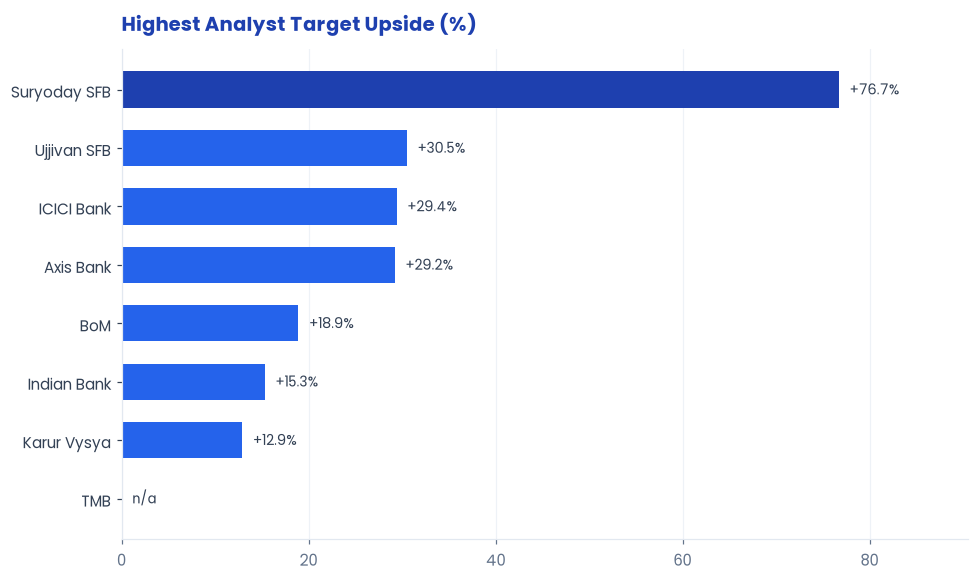
| Bank | CMP (₹) | Highest Target (₹) | Upside |
|---|---|---|---|
| ICICI Bank | 1,430 | 1,850 (Prabhudas Lilladher) | +29.4% |
| Axis Bank | 1,255 | 1,622 (Anand Rathi) | +29.2% |
| Tamilnad Mercantile | 897.60 | — | — |
| Karur Vysya Bank | 354.35 | 400 (ICICI Securities) | +12.9% |
| Bank of Maharashtra | 85.60 | 101.75 (TradingView) | +18.9% |
| Indian Bank | 889 | 1,025 (Motilal Oswal) | +15.3% |
| Ujjivan SFB | 68.99 | 90 (ICICI Securities) | +30.5% |
| Suryoday SFB | 158.43 | 280 (TradingView) | +76.7% |
TMB has no published analyst target. Suryoday's upside is highest but reflects a single TradingView target and a weaker asset-quality book, so the higher upside compensates for higher risk.
Net Profit — Q1 FY27
ICICI Bank posted the highest net profit of the eight at ₹14,805 crore, followed by Axis Bank at ₹7,114 crore. Ujjivan and Suryoday grew fastest off a low base.
| Bank | PAT (₹ Cr) | YoY |
|---|---|---|
| ICICI Bank | 14,805 | +15.9% |
| Axis Bank | 7,114 | +23% |
| Indian Bank | 3,273 | +10.1% |
| Bank of Maharashtra | 2,020 | +26.8% |
| Karur Vysya Bank | 756 | +44.9% |
| Tamilnad Mercantile | 412 | +35.0% |
| Ujjivan SFB | 317 | +206.7% |
| Suryoday SFB | 75.2 | +113.1% |
Profitability — ROE, ROA & NIM
Bank of Maharashtra leads on ROE (22.6%), followed by Karur Vysya (20.8%). Ujjivan tops ROA (2.2%) and NIM (8.5%) on its microfinance-led book. Among traditional banks, TMB has the highest ROA (2.14%).
| Bank | ROE | ROA | NIM |
|---|---|---|---|
| ICICI Bank | 15.9% | ~2.0% | ~4.0% |
| Axis Bank | 13.1% | 1.51% | ~3.8% |
| Tamilnad Mercantile | 15.6% | 2.14% | ~3.8% |
| Karur Vysya Bank | 20.8% | 2.11% | ~4.0% |
| Bank of Maharashtra | 22.6% | 1.90% | 2.70% |
| Indian Bank | 19.5% | 1.31% | 3.41% |
| Ujjivan SFB | 18.2% | 2.2% | 8.5% |
| Suryoday SFB | 14.5% | 1.6% | 7.2% |
ROA is annualized for the quarter. NIM marked ~ is computed or estimated where the bank does not disclose it.
Asset Quality — GNPA vs NNPA
TMB has the lowest GNPA (0.69%), while Bank of Maharashtra has the lowest NNPA (0.13%) and the highest PCR (98.6%). Suryoday is the laggard with GNPA of 6.5% from the microfinance stress cycle.
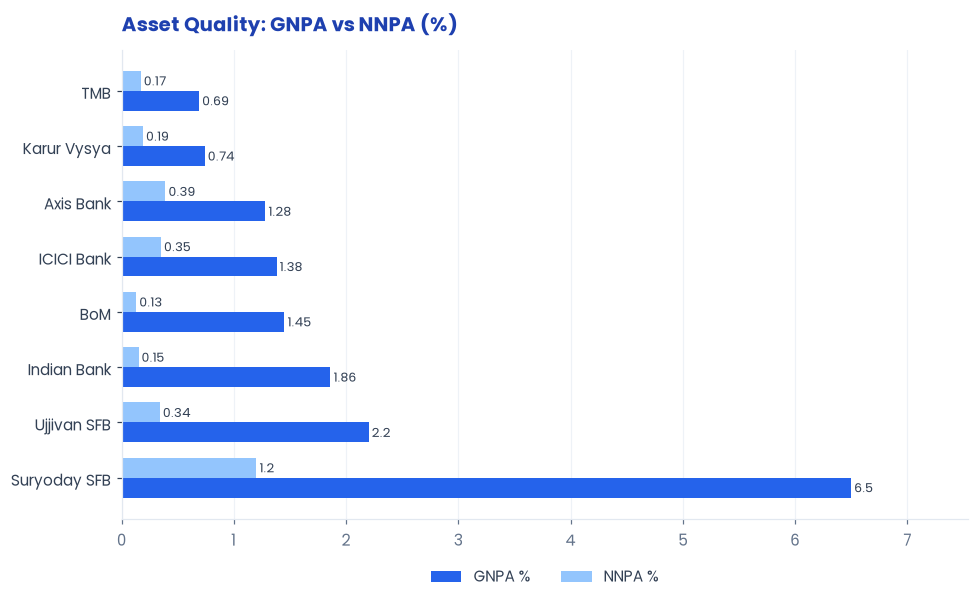
| Bank | GNPA | NNPA | PCR |
|---|---|---|---|
| ICICI Bank | 1.38% | 0.35% | — |
| Axis Bank | 1.28% | 0.39% | — |
| Tamilnad Mercantile | 0.69% | 0.17% | 75.4% |
| Karur Vysya Bank | 0.74% | 0.19% | 96.2% |
| Bank of Maharashtra | 1.45% | 0.13% | 98.6% |
| Indian Bank | 1.86% | 0.15% | 98.2% |
| Ujjivan SFB | 2.2% | 0.34% | ~84% |
| Suryoday SFB | 6.5% | 1.2% | 81.8% |
PCR for ICICI and Axis Bank is not disclosed. Suryoday's GNPA/NNPA include a CGFMU receivable against its NNPA.
Valuation — P/E and P/B
Suryoday is the cheapest at 0.81x book, followed by TMB (1.35x) and Indian Bank (1.43x). ICICI Bank is the most expensive at 2.72x book. Bank of Maharashtra (8.7x) and Suryoday (8.8x) offer the lowest P/E.
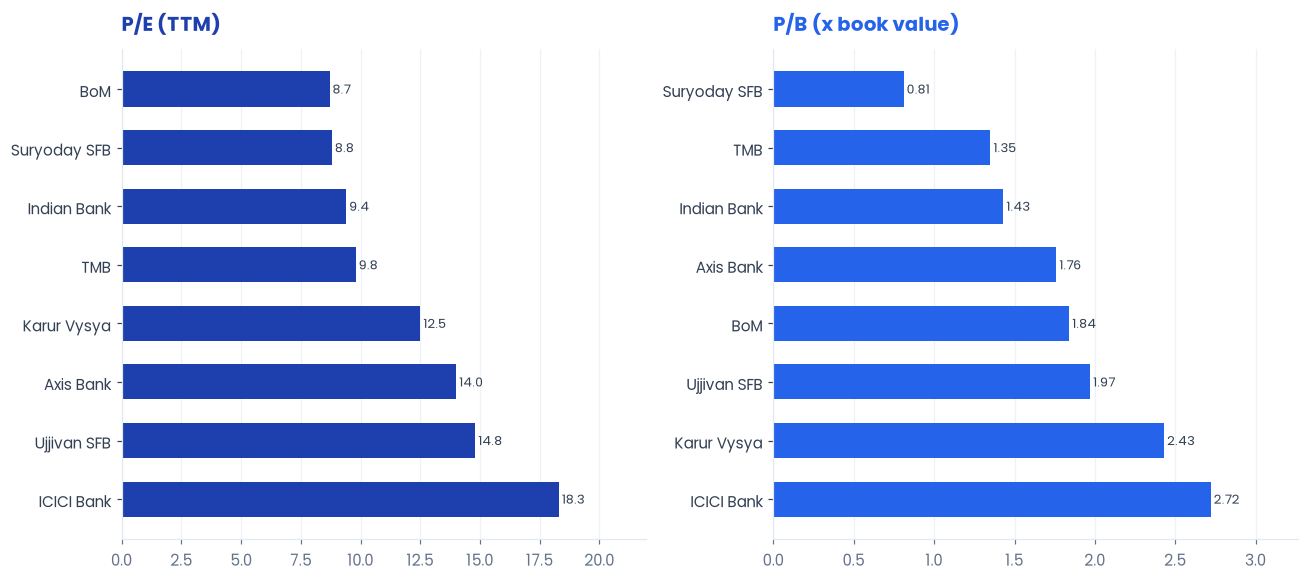
| Bank | CMP (₹) | P/E | P/B | Div Yield |
|---|---|---|---|---|
| ICICI Bank | 1,430 | 18.3 | 2.72 | 0.84% |
| Axis Bank | 1,255 | 14.0 | 1.76 | 0.08% |
| Tamilnad Mercantile | 897.60 | 9.8 | 1.35 | 1.39% |
| Karur Vysya Bank | 354.35 | 12.5 | 2.43 | 0.73% |
| Bank of Maharashtra | 85.60 | 8.7 | 1.84 | 2.57% |
| Indian Bank | 889 | 9.4 | 1.43 | 2.05% |
| Ujjivan SFB | 68.99 | 14.8 | 1.97 | 0.00% |
| Suryoday SFB | 158.43 | 8.8 | 0.81 | 0.95% |
Prices as of 26 August 2026. P/E, P/B and dividend yield from Screener.in (26 August 2026 close).
Balance Sheet & Growth — Q1 FY27
ICICI Bank and Axis Bank dwarf the others on deposits and advances. Suryoday grew the fastest (advances +32.5%), followed by Ujjivan and TMB.
| Bank | Deposits (₹ Cr) | Dep Growth | Advances (₹ Cr) | Adv Growth |
|---|---|---|---|---|
| ICICI Bank | 18,30,020 | +14.0% | ~15,50,000 | +19.6% |
| Axis Bank | 13,33,791 | +18% | ~11,70,000 | +19% |
| Indian Bank | 8,27,654 | +13.5% | 6,84,623 | +13.9% |
| Bank of Maharashtra | 3,50,538 | +14.1% | — | — |
| Karur Vysya Bank | 1,15,666 | +13.3% | — | — |
| Tamilnad Mercantile | 64,409 | +19.7% | 57,040 | +27.5% |
| Ujjivan SFB | 48,129 | +24.6% | 42,903 | +29% |
| Suryoday SFB | 14,634 | +29.4% | 14,376 | +32.5% |
KVB and Bank of Maharashtra do not disclose advances or advance growth in their Q1 releases, so those cells are left blank.
Final Ranking — 8-Bank Scorecard
Each bank is ranked 1–8 on every metric (best = 8, worst = 1). Lower is better for P/B, P/E, GNPA and NNPA; higher is better for the rest. Overall (max 72) = Valuation (16) + Profitability (24) + Asset Quality (16) + Growth (8) + Analyst Upside (8). Ties are broken by asset quality.
| Rank | Bank | Val (16) | Prof (24) | AQ (16) | Grw (8) | Upside (8) | Overall (72) |
|---|---|---|---|---|---|---|---|
| 1 | Ujjivan SFB | 5 | 21 | 6 | 8 | 7 | 47 |
| 2 | Tamilnad Mercantile | 12 | 13 | 14 | 5 | 1 | 45 |
| 3 | Bank of Maharashtra | 12 | 13 | 12 | 4 | 4 | 45 |
| 4 | Karur Vysya Bank | 6 | 18 | 12 | 6 | 2 | 44 |
| 5 | Suryoday SFB | 15 | 12 | 2 | 7 | 8 | 44 |
| 6 | Indian Bank | 12 | 9 | 10 | 1 | 3 | 35 |
| 7 | ICICI Bank | 2 | 15 | 8 | 2 | 6 | 33 |
| 8 | Axis Bank | 8 | 7 | 8 | 3 | 5 | 31 |
This scorecard ranks the stock, not the business. Smaller banks win on valuation and growth because they trade at a fraction of ICICI's or Axis's multiples. Ujjivan tops the table on profitability (ROE 18.2%, NIM 8.5%) and grew profit +206.7%; TMB combines the cleanest book with the highest traditional-bank ROA; Karur Vysya and Bank of Maharashtra lead on ROE. ICICI and Axis are stronger, safer businesses, but their premium valuations and slower growth drag them down here.
Conclusion
The scorecard favours smaller, cleaner and cheaper banks as stocks: Ujjivan, TMB, Bank of Maharashtra and Karur Vysya lead, while ICICI and Axis trail on valuation and growth despite being the strongest businesses. Your pick depends on what you are optimising for — quality, profitability, value or balance.
References
- Screener.in — Bank Stock Data and Peer Comparison
- TradingView — Analyst Price Targets
- ICICI Bank Q1 FY27 Financial Results — BSE
- Axis Bank Q1 FY27 Financial Results — BSE
- Tamilnad Mercantile Bank Q1 FY27 Results — BSE
- Karur Vysya Bank Q1 FY27 Results — BSE
- Bank of Maharashtra Q1 FY27 Results — BSE
- Indian Bank Q1 FY27 Press Release
- Ujjivan SFB Q1 FY27 Investor Presentation
- Suryoday SFB Q1 FY27 Investor Presentation
- Reserve Bank of India — Banking Statistics
All numbers from Q1 FY27 earnings presentations, press releases and BSE filings. Current prices as of 26 August 2026; P/E, P/B and market cap from NSE / Screener.in (mid-August 2026 close). Analyst targets from brokerage research and TradingView. Values marked ~ are computed or estimated where the bank does not disclose the metric.
This analysis is for educational purposes only and does not constitute investment advice. Please consult a SEBI-registered investment adviser before making any investment decision.
- #Best Bank Stocks 2026
- #Bank Stock Comparison
- #ICICI Bank
- #Axis Bank
- #Tamilnad Mercantile Bank
- #Karur Vysya Bank
- #Bank of Maharashtra
- #Indian Bank
- #Ujjivan Small Finance Bank
- #Suryoday Small Finance Bank
- #Q1 FY27 Results
- #Large Cap vs Mid Cap Banks
- #PSU Bank Stocks
- #Small Finance Banks
- #Bank Ranking 2026
- #Bank Scorecard
- #Analyst Price Target
- #GNPA NNPA
- #NIM ROE ROA
- #CASA Ratio
- #P/E P/B Valuation
- #Banking Sector Analysis India
- #Fundamental Analysis
- #Bank Stocks
- #Stock Market India
- #Investing India
Frequently asked questions
Which bank topped the 8-bank Q1 FY27 scorecard?
Ujjivan SFB tops our 8-bank scorecard with 47/72 points — the highest profitability (ROE 18.2%, NIM 8.5%) and the fastest profit growth (+206.7%). Tamilnad Mercantile Bank follows at 45/72 with the cleanest book (GNPA 0.69%, NNPA 0.17%) and the highest ROA among traditional banks (2.14%). This is not investment advice.
Which of the 8 banks has the best asset quality?
Tamilnad Mercantile Bank has the lowest GNPA (0.69%) and second-lowest NNPA (0.17%), while Bank of Maharashtra has the lowest NNPA (0.13%) and highest PCR (98.6%). Karur Vysya Bank (GNPA 0.74%, NNPA 0.19%) is also among the cleanest books.
Which of the 8 banks has the highest analyst upside?
Suryoday Small Finance Bank has the highest analyst upside at about +76.7% (TradingView target ₹280 vs ₹158.43), followed by Ujjivan SFB at +30.5% (ICICI Securities target ₹90 vs ₹68.99) and ICICI Bank at +29.4% (Prabhudas Lilladher target ₹1,850). Tamilnad Mercantile Bank has no published analyst target. This is not investment advice.
Which bank is the cheapest by P/B ratio?
Suryoday Small Finance Bank trades at the lowest P/B of 0.81x among the 8 banks, followed by TMB (1.35x) and Indian Bank (1.43x). ICICI Bank is the most expensive at 2.72x book, reflecting its premium large-cap franchise.
Which large-cap bank is better — ICICI or Axis?
On valuation and profit growth, Axis Bank scores slightly higher (P/B 1.76x vs 2.72x, PAT growth ~23% vs 15.9%), while ICICI Bank leads on profitability (ROE 15.9% vs 13.1%) and asset quality. Both carry strong analyst targets: ICICI up to ₹1,850 and Axis up to ₹1,622. This is not investment advice.
Related articles

Investing16 min read

Investing12 min read

Investing11 min read
Stay ahead on finance & AI
Weekly articles on personal finance, investing strategies, and how AI is changing the way we manage money. Free. No spam.
Join free · Unsubscribe anytime · We never share your email.