Petrol, Diesel, CNG, Hybrid or EV: Which Car to Buy in 2027?
Petrol, diesel, CNG, hybrid or electric car in India? Running cost per km, E20 mileage, CNG boot space, hybrid payback, EV charging and resale, and the best pick by budget.
· 10 min read
Buying a car in India is no longer just "petrol or diesel." You can choose petrol, diesel, CNG, hybrid, or fully electric. The right choice depends on your budget, how much you drive, and where you can refuel or charge.
The market is already changing. In August 2026, petrol cars made up only 40.9% of passenger vehicle sales. CNG reached 25.3%, hybrids 9.0%, and electric cars 7.6%. Together, these alternatives (41.9%) outsold petrol.
This post explains each option in simple terms and ends with the best choice for each budget in 2027. If you are also deciding how to pay for the car, read Cash vs. Loan vs. Lease: Best Way to Buy a Car? and try the car cash vs loan vs lease calculator.
What Each Option Costs to Run
Here is what each type costs per kilometer at Delhi prices in October 2026.
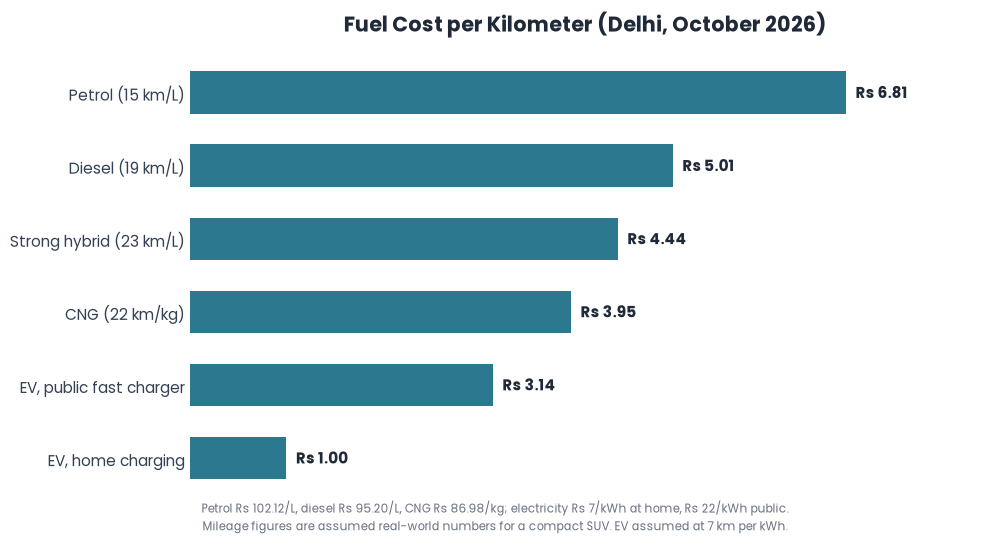
| Fuel type | Cost per km | Yearly cost at 12,000 km |
|---|---|---|
| Petrol | Rs 6.81 | Rs 81,700 |
| Diesel | Rs 5.01 | Rs 60,100 |
| Strong hybrid | Rs 4.44 | Rs 53,300 |
| CNG | Rs 3.95 | Rs 47,400 |
| EV, public fast charging | Rs 3.14 | Rs 37,700 |
| EV, home charging | Rs 1.00 | Rs 12,000 |
Prices: petrol Rs 102.12 per liter, diesel Rs 95.20 per liter, CNG Rs 86.98 per kg, electricity Rs 7 per unit at home and Rs 22 at a public fast charger. Mileage is an assumed real-world figure for a compact SUV. Your numbers will differ by city and driving style.
Tax matters too. Since September 22, 2025, small cars (under 4 meters, petrol engine up to 1,200 cc or diesel up to 1,500 cc) pay 18% GST. Bigger cars pay 40%, and electric cars just 5%.
Petrol
Petrol is still the default choice, and for many buyers it remains the right one.
Advantages
- Lowest purchase price and the widest choice of models.
- Many automatic options, from AMT to DCT and CVT.
- Easy to sell later, because used petrol cars are always in demand.
Disadvantages
- The highest running cost, at about Rs 6.8 per km.
- E20 mileage drop. Almost all pumps now sell E20 petrol (20% ethanol). The petroleum ministry says mileage falls 1–2% in cars calibrated for E20 and 3–6% in older cars. Ethanol is also costlier to produce, so prices have not come down to offset this.
- Older cars. E20-compliant cars began rolling out in April 2023, so older cars were not designed for it. The ministry says some rubber parts and gaskets in older cars may need replacing after 20,000–30,000 km. The carmakers' body, SIAM, has said warranty and insurance claims will be honored.
Best for: people who drive less than about 1,000 km a month, or who want the cheapest car to buy.
Diesel
Diesel was once the default for high-mileage drivers. Today, it is mostly found in larger SUVs, which make up 94% of diesel sales.
Advantages
- Strong pulling power, which is useful for highways, full loads, hills, and towing.
- Better mileage than petrol on long trips.
- Available in 4x4 and seven-seat SUVs where few other options exist.
Disadvantages
- Small price gap. In Delhi, diesel now costs Rs 95.20 per liter, only about 7% less than petrol. Diesel cars also cost more to buy, so at about 1,000 km a month the fuel savings take a long time to recover the higher price.
- BS6 problems. BS6 diesel cars have a diesel particulate filter (DPF) that cleans itself only during sustained highway driving. Short city trips can clog it, which is an expensive repair. Some SUVs also need AdBlue, a fluid you have to refill.
- 10-year limit in Delhi-NCR. Court orders bar diesel cars older than 10 years from Delhi-NCR roads. The Supreme Court paused action against owners in August 2025, but the rule has not been removed.
- Shrinking future. Maruti Suzuki has stopped making diesel cars. New fuel-efficiency rules (CAFE 3), which start in April 2027, give carmakers extra credit for electric cars and some hybrids, so expect fewer small diesel cars.
Best for: people who drive mostly on highways, more than 2,000 km a month, in a large SUV.
CNG
CNG is the cheapest way to run a fuel-powered car, which is why it now makes up a quarter of sales.
Advantages
- Low running cost, at about Rs 4 per km.
- The car also runs on petrol, so you are never stranded.
- Small CNG cars pay only 18% GST.
- Factory-fitted CNG keeps the full company warranty.
Disadvantages
- Lost boot space. A standard dealer-fitted CNG cylinder can take up 150–160 liters of boot space, which is most of a small car's luggage room.
- Less power, especially with a full load or on hills.
- Queues at CNG stations, and fewer stations outside big cities.
- Most CNG cars are manual.
Current solutions to the boot problem
| Solution | Example | Boot space left |
|---|---|---|
| Twin cylinders under the boot floor | Tata Punch iCNG | about 210 liters |
| Split tank (Hy-CNG Duo) | Hyundai Exter CNG | about 225 liters |
| Tank under the car body | Maruti Victoris, Brezza CNG | about 328 liters (Brezza) |
Best for: city drivers who travel 1,000–2,000 km a month and have a CNG station nearby. Choose a factory-fitted car with a twin-cylinder or underbody tank.
Hybrid: Clearing Up the Confusion
"Hybrid" is the most confusing label in the market, because three very different technologies use the same word.
| Type | How it works | Mileage gain | Examples |
|---|---|---|---|
| Mild hybrid | A small battery helps the engine start and stop | Small | Many Maruti "Smart Hybrid" models |
| Strong hybrid | A larger battery can drive the car on its own at low speed, and it charges itself | Large | Maruti Victoris, Grand Vitara, Toyota Hyryder, Honda City e:HEV, Innova Hycross |
| Plug-in hybrid | A big battery you charge from a socket | Large if charged daily | Rare and expensive in India |
When people talk about hybrid savings, they mean a strong hybrid. The Grand Vitara strong hybrid claims about 28 km per liter, and real-world use gives about 23–25 km per liter.
Advantages
- About 35% lower fuel cost than petrol, with no charging needed.
- Automatic as standard, and very smooth and quiet in city traffic.
- Some states have offered road tax relief. Uttar Pradesh waived road tax on strong hybrids in 2024 under an EV policy with a three-year term, so check what applies in your state today.
Disadvantages
- High upfront cost. A strong hybrid costs noticeably more than the petrol version of the same car.
- Slow payback. Here is the time it takes to recover a Rs 2 lakh premium over a petrol automatic that does 16 km per liter:
| Km a year | Petrol | Hybrid | Saving | Payback |
|---|---|---|---|---|
| 12,000 | Rs 76,600 | Rs 53,300 | Rs 23,300 | 8.6 years |
| 20,000 | Rs 1,27,700 | Rs 88,800 | Rs 38,900 | 5.1 years |
- Large cars pay 40% GST, the same as petrol, and Delhi dropped its planned tax relief for hybrids in its 2026 EV policy.
- The battery takes up some boot space.
Best for: people who drive more than 1,500 km a month, mostly in city traffic, and plan to keep the car for 7 years or more.
Pure Electric (EV)
An EV has the lowest running cost of any car, but it asks the most questions before you buy.
Advantages
- About Rs 1 per km with home charging, roughly one-seventh the cost of petrol.
- Only 5% GST, and road tax waivers in many states.
- Instant pickup, a silent drive, and very little maintenance (no oil changes or clutch).
- Lifetime battery warranties for the first private owner on some models, such as the Tata Nexon EV 45, Curvv EV, and Harrier EV, and the Mahindra BE 6 and XEV 9e (conditions apply).
Disadvantages
- High upfront cost. EVs cost more than petrol cars of the same size. Battery rental plans lower the price, but they add a per-km fee. For example, the Maruti e Vitara's battery rental costs Rs 3.99 per km. Add electricity, and that is close to diesel's running cost.
- Charging outside the home. India has 52,718 public charging stations, but only 16,561 have fast chargers suitable for cars, and coverage thins out beyond the big cities. Public fast charging costs about three times as much as home charging.
- Resale is uncertain. A 2026 Autocar India study of more than 11,000 used-car sales found no clear resale benchmarks for EVs yet, mainly because buyers worry about battery health.
Best for: people with home or office charging who drive mostly in the city or on known routes.
Best Option to Buy in 2027 by Budget
Under Rs 10 lakh
- Low driving (under 1,000 km a month): petrol, such as the Maruti Swift, Dzire, or Tata Punch.
- High city driving: factory CNG, such as the Tata Punch iCNG, Hyundai Exter CNG, or Maruti Dzire CNG.
- Home charging available: an EV, such as the Tata Tiago EV (from about Rs 7 lakh) or Punch EV (from Rs 9.79 lakh).
Rs 10–20 lakh
- Low driving: petrol, or a CNG SUV with an underbody tank, such as the Maruti Brezza or Victoris CNG.
- High city driving: a strong hybrid, such as the Maruti Victoris or Grand Vitara, Toyota Hyryder, or Honda City e:HEV.
- Home charging available: an EV, such as the Tata Nexon EV, MG Windsor, or Maruti e Vitara (from Rs 16.19 lakh).
Rs 20–30 lakh
- Low driving: a petrol SUV.
- High city driving: a strong-hybrid MPV, such as the Toyota Innova Hycross.
- Home charging available: an EV, such as the Mahindra BE 6 (from about Rs 19.5 lakh).
Ex-showroom prices as of October 2026. Models are examples of each type, not endorsements. Check current prices before you buy.
Diesel fits only one case in 2027: you drive mostly on highways, more than 2,000 km a month, and want a large or seven-seat SUV.
A Simple Way to Decide
- Charging at home or work, mostly city driving? Buy an EV.
- No charging, but lots of city driving? Buy a strong hybrid for an automatic, or factory CNG for the lowest cost.
- Less than 1,000 km a month? Buy petrol. The extra price of the others takes too long to recover.
- Long highway trips in a big SUV? Diesel still makes sense.
Conclusion
There is no single best fuel type in 2027. EVs are cheapest to run if you can charge at home. CNG is the budget pick for high city mileage. Strong hybrids suit heavy drivers who want an automatic. Petrol suits low mileage, and diesel now fits only highway-heavy SUV owners.
This analysis is for educational purposes only and does not constitute investment advice.
References
- Petroleum Ministry statement on E20 mileage and older vehicles and The Week: Govt says E20 may reduce mileage by 3–5%
- Reuters via Malay Mail: Carmakers say ethanol fuel hurts mileage but is safe and Business Standard: Carmakers assure warranty cover for older vehicles using E20
- Autocar India: New GST rates for cars
- Angel One: Alternative fuel vehicles overtake petrol, August 2026
- Punjab Kesari: Petrol and diesel rates, October 21, 2026 and CarDekho: CNG price in Delhi
- Autopunditz: Passenger vehicle sales by fuel type, H1 2026 and The Goan: Maruti exits diesel
- Autocar India: Petrol or diesel for 1,000 km a month and AutoDecode: BS6 DPF and AdBlue guide
- Upstox: Supreme Court on end-of-life vehicles in Delhi-NCR and Autopunditz: CAFE 3 norms
- CarHP: CNG cars with big boot space and My Car Junction: Boot space lost to CNG cylinders
- Spinny: Grand Vitara petrol vs CNG vs strong hybrid mileage
- Autocar Pro: Uttar Pradesh road tax waiver on strong hybrids and Autocar Pro: Delhi drops hybrid tax relief
- Lok Sabha reply on public charging stations, July 2026 (via ThatsMyEV)
- Autocar India: Maruti e Vitara price and battery subscription and CarDekho: Electric car prices
- Spinny: EV brands with the longest battery warranty and Analytics Insight: Battery health and used EV prices
Prices and rules are as of October 2026 and change often. Check current figures with the manufacturer, your dealer, and your state transport department before buying.
- #Car Buying
- #Petrol vs Diesel
- #CNG Cars
- #Hybrid Cars
- #Strong Hybrid
- #Electric Cars
- #EV vs Petrol
- #E20 Petrol
- #BS6 Diesel
- #CNG Boot Space
- #EV Charging
- #EV Resale Value
- #Running Cost per km
- #GST on Cars
- #CAFE 3 Norms
- #Best Cars 2027
- #India Car Prices
- #Personal Finance
- #CarBuyingIndia
- #PetrolVsDiesel
- #CNGCars
- #HybridCars
- #ElectricCars
- #EVIndia
Frequently asked questions
Which car type has the lowest running cost in India?
An EV charged at home, at about Rs 1 per km. Among fuel-powered cars, CNG is cheapest at about Rs 4 per km. Petrol costs about Rs 6.8 per km at Delhi prices.
Does E20 petrol reduce mileage?
Yes, slightly: 1–2% for cars calibrated for E20 and 3–6% for older cars, according to the petroleum ministry.
When does a strong hybrid pay back its higher price?
If it costs Rs 2 lakh more than a petrol automatic, about 8.6 years at 12,000 km a year, or about 5 years at 20,000 km a year.
Related articles

Personal Finance6 min read

Personal Finance8 min read

Personal Finance5 min read
Stay ahead on finance & AI
Weekly articles on personal finance, investing strategies, and how AI is changing the way we manage money. Free. No spam.
Join free · Unsubscribe anytime · We never share your email.